News | 08/05/2025

Important step towards improving the diagnosis and treatment of brain metastases

Brain metastases often occur as a result of advanced cancer and, despite medical advances, are still associated with a poor prognosis. Now an international panel of experts led by the LMU Clinic and the Medical University of Vienna has taken an important step towards improving diagnostics and therapy monitoring. A special imaging technique, amino acid PET, can not only improve patient care, but also advance research into the development of new treatment approaches. The first standardized criteria for the use of this method were recently published in the top journal "Nature Medicine".
Prof. Dr. Nathalie Albert, Senior Physician at the Clinic for Nuclear Medicine at LMU Hospital

Until now, magnetic resonance therapy (MRI) has mainly been used for the diagnosis and therapy monitoring of brain metastases. However, this method cannot show the metabolic activity of tumor cells. For this reason, amino acid positron emission tomography (amino acid PET) is increasingly being used in research, but also in the treatment of patients with brain metastases. This imaging procedure uses radioactively labeled substances to achieve a more precise assessment of tumor metabolism and thus a more precise assessment of tumor response to therapy. The amino acid tracers used in this process preferentially accumulate in cancer cells and can therefore detect the tumor burden more accurately than conventional MRI techniques

Targeted evaluation of therapy options

Image without a title
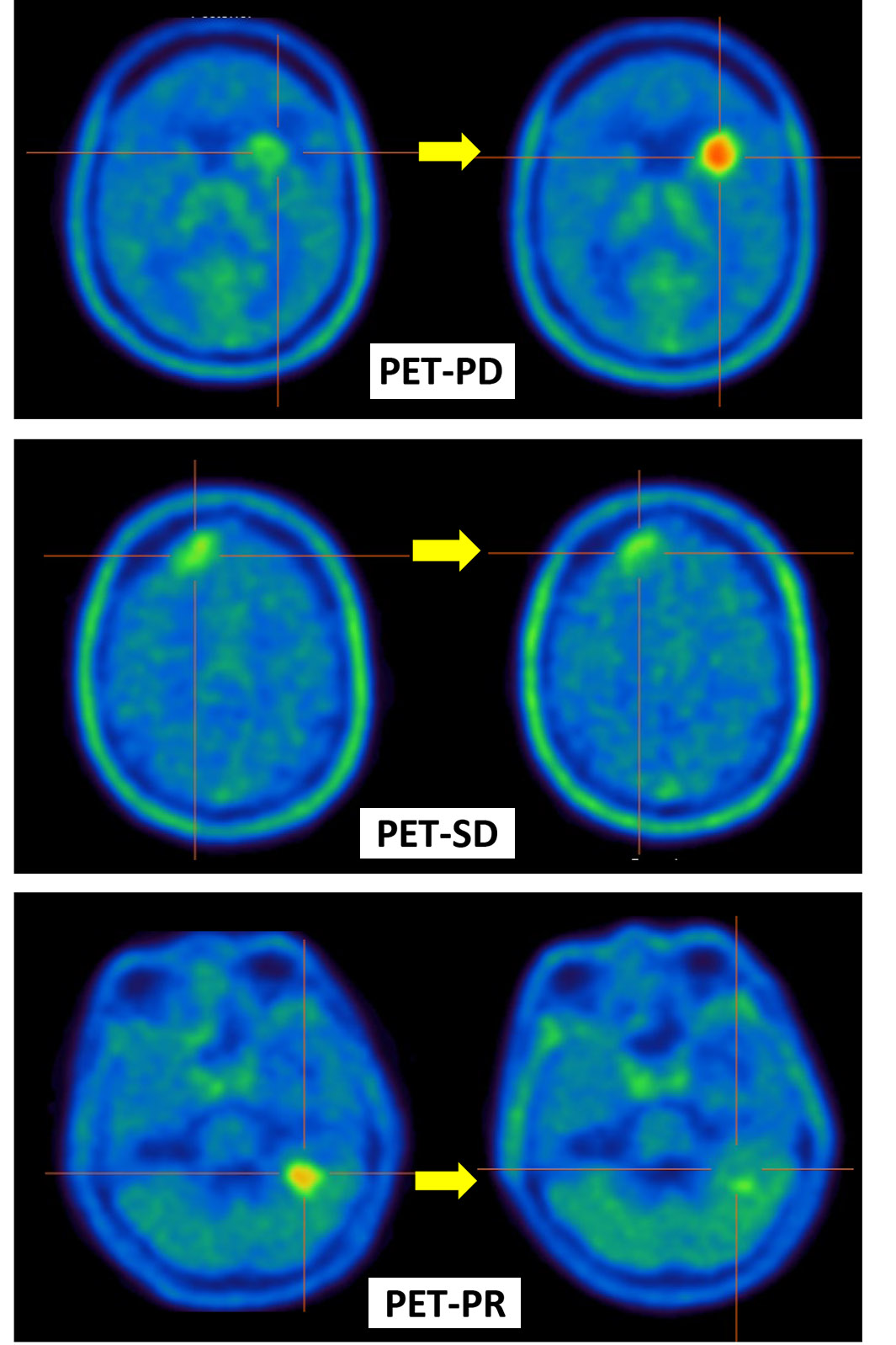
Amino acid PET can detect changes in tumor activity when assessing the progression of brain metastases. The example images show the changes in tumor activity in progressive disease ("PET-PD"), stable disease ("PET-SD") and partial response to therapy ("PET-PR").

Despite its increased use in research and clinical routine, there are still no standardized criteria for the use of amino acid PET in brain metastases. These have now been established by an international research group, the so-called RANO group, led by oncologist Matthias Preusser from the Medical University of Vienna and nuclear medicine specialist Nathalie Albert from the LMU Hospital in Munich. Maximilian J. Mair and Anna S. Berghoff (Division of Oncology, Department of Medicine I) from MedUni Vienna are also involved in the ground-breaking work. The criteria, called "PET RANO BM 1.0", are the first to define a standardized procedure for assessing the metabolic response of brain metastases to treatment. This means that PET imaging could be integrated more closely into clinical trials in future in order to evaluate new treatment options in a targeted manner.

"The introduction of the new criteria is an important step towards improving the diagnosis and treatment monitoring of brain metastases," says Matthias Preusser, Head of the Division of Oncology at MedUni Vienna. It may also allow a more precise distinction to be made between genuine tumor changes and treatment-related effects such as tissue damage following radiotherapy. "This could not only optimize patient care, but also accelerate the development of innovative treatment strategies," adds Nathalie Albert, Senior Physician at the Department of Nuclear Medicine at LMU Hospital in Munich and Professor of Nuclear Medicine with a focus on neuro-oncology.

English version of press release

Publication

RANO criteria for response assessment of brain metastases based on amino acid PET imaging
Nathalie L. Albert, Norbert Galldiks, Benjamin M. Ellingson, Martin J. van den Bent, Susan M. Chang, Francesco Cicone, Eng-Siew Koh, Ian Law, Emilie Le Rhun, Maximilian J. Mair, Jan-Michael Werner, Anna S. Berghoff, Julia Furtner, Giuseppe Minniti, Andrew M. Scott, Susan C. Short, Jana Ivanidze, Derek R. Johnson, Bogdana Suchorska, Nelleke Tolboom, Joerg-Christian Tonn, Antoine Verger, Eva Galanis, Priscilla K. Brastianos, Patrick Y. Wen, Michael Weller, Nancy U. Lin, Matthias Preusser.
Nature Medicine:
https://doi.org/10.1038/s41591-025-03633-7

contact

Prof. Dr. med. Nathalie Albert

Neurooncological Nuclear Medicine Working Group, Clinic and Polyclinic for Nuclear Medicine

Originally translated with DeepL