Start of the first BZKF clinical trials: New hope for people with leukemia and prostate cancer
The Bavarian Center for Cancer Research (BZKF) is funding two of its own clinical studies for the first time with a total of 5.2 million euros. New approaches for the treatment of acute myeloid leukemia (ERASE-AML) and for more precise prostate cancer diagnosis (PRIME) are being investigated. All six Bavarian university hospitals are participating in both studies. The aim of the BZKF funding is to give cancer patients in Bavaria early access to innovative diagnostic and therapeutic procedures.
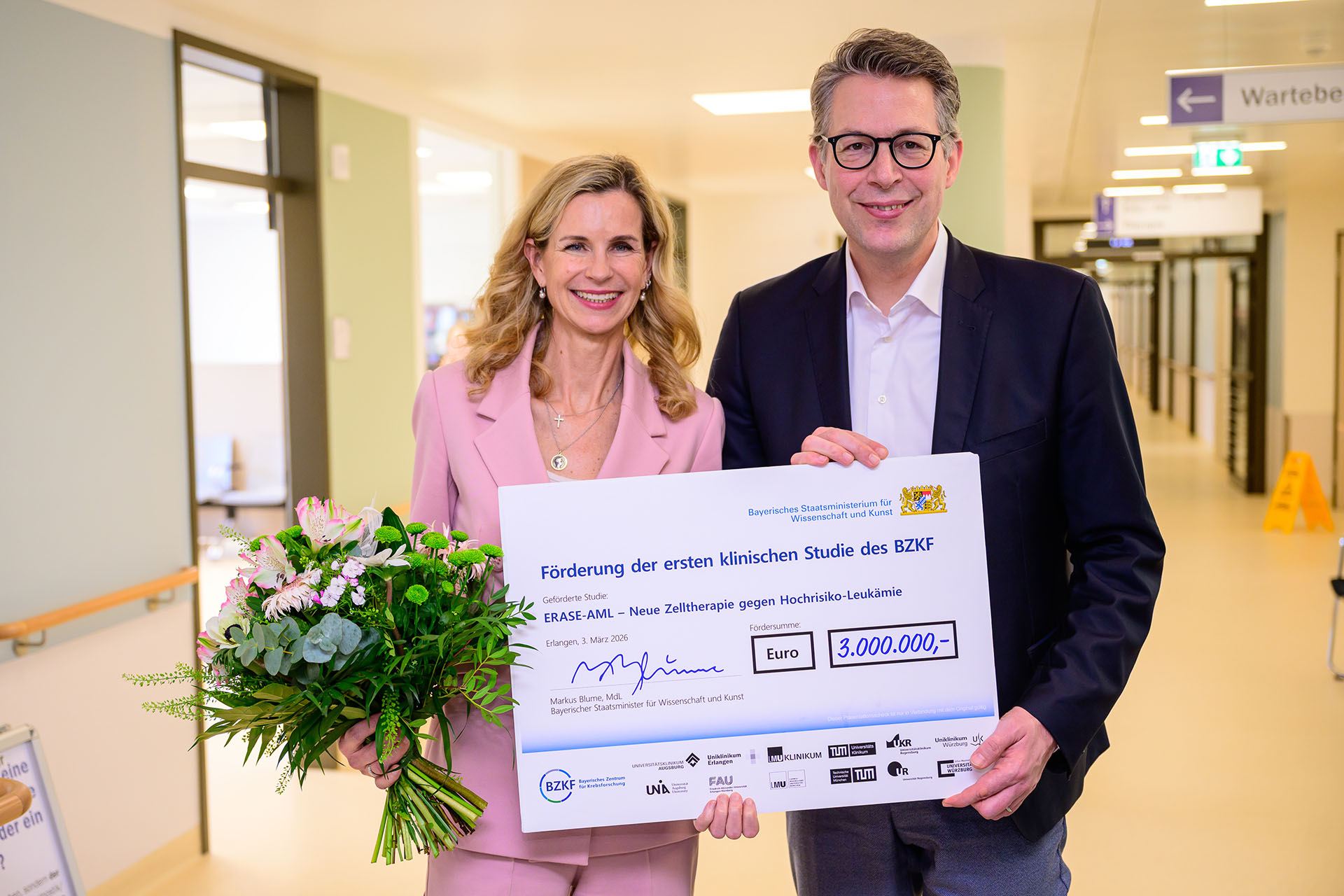
Science Minister Markus Blume emphasizes: "Scientific excellence is turning into concrete hope: for the first time, the BZKF is launching its own clinical trials - thus building a bridge from research to concrete application. The focus is on leukemia and prostate cancer - two areas in which medical progress is urgently needed. What starts here today is the visible result of a strong network. For six years, our six Bavarian university hospitals have been fighting together in the BZKF against the great scourge of humanity. Under the motto 'Sharing knowledge, healing people', each hospital contributes its strengths - from AI to immunotherapy. The Free State of Bavaria has supported the center with over 72 million euros since it was founded. With this efficient and networked infrastructure, we provide cutting-edge oncology medicine in all regions of Bavaria. The BZKF is a living responsibility and a great promise: We want to defeat cancer. Many thanks to everyone who works on this every day."
ERASE-AML: New cell therapy against aggressive leukemia (blood cancer)
The ERASE-AML study is aimed at patients with acute myeloid leukemia (AML), a particularly aggressive form of blood cancer. Despite modern treatment methods, the chances of recovery are still limited: Only around 3 in 10 people affected are alive five years after diagnosis. The risk of relapse is particularly high if minimal remnants of the leukemia remain in the body after treatment or if genetic changes make the cancer cells particularly resistant. For many patients, a transfer of foreign stem cells that have previously been tested for a match (allogeneic stem cell transplantation) is the only chance of a cure. Nevertheless, relapses often occur - and effective treatment options are then limited.
With ERASE, we are able to test an innovative cell therapy approach in a clinical trial for AML for the first time. Close cooperation within the BZKF network is particularly important here. Only through this cross-site structure is it possible to jointly and quickly bring new scientific ideas into clinical application.
Prof. Marion Subklewe, Head of Cellular Immunotherapy at the LMU Clinic
The ERASE-AML study is testing a novel form of personalized cell-based immunotherapy. In this process, immune cells (T cells) from a stem cell donor are specifically stimulated in the laboratory with several leukemia-specific protein components (peptides). This creates a broadly effective immune response directed against various leukemia characteristics. In addition, the T-cells are equipped with a chimeric co-stimulating antigen receptor (an artificially combined docking and activation structure - CARs), which is intended to enhance the activity of the T-cells in the body. These "trained" and specifically boosted T cells are used in patients with a high risk of relapse or early relapse after stem cell transplantation. The aim is to permanently eliminate remaining leukemia cells and prevent relapses. The study is being led by Dr. Veit Bücklein and Prof. Dr. Marion Subklewe (LMU University Hospital Munich). The funding volume amounts to around 3 million euros.
PRIME: Better diagnosis, less stress for patients with prostate cancer
The PRIME study is investigating how prostate cancer - one of the most common types of cancer in men - can be detected more precisely and more patient-friendly. Until now, an elevated PSA level in the blood and an abnormal MRI scan have usually been followed by a biopsy. For many patients, this examination is very physically and emotionally stressful - unpleasant, painful and associated with possible infections. In addition, it is not uncommon for harmless findings to be made that do not require treatment. The PRIME study will examine whether additional modern imaging (positron emission tomography (PET) / computer tomography (CT)) can further improve the diagnosis. With PSMA-PET/CT, prostate cancer cells can be visualized even more precisely using a very small amount of a radioactive drug. In the study, 150 men with abnormal MRI scans will also receive this examination. Depending on the results, fewer or more targeted biopsies should then be necessary for the reliable diagnosis of prostate cancer requiring treatment. The aim is to detect aggressive tumors early and reliably while avoiding unnecessary interventions. The study is being led by Prof. Dr. Matthias Eiber (TUM Klinikum München) and Prof. Dr. Matthias Heck (Augsburg University Hospital). The funding amounts to 2.2 million euros.
Strong collaboration for better cancer research in Bavaria
Both studies are conducted across all six BZKF locations: Augsburg, Erlangen, Munich (LMU and TUM), Regensburg and Würzburg. "These studies mark an important milestone for the BZKF," says Prof. Dr. Andreas Mackensen, Director of the BZKF. "Patients throughout Bavaria can take part in early clinical trials with innovative approaches - without having to travel long distances."
Ortwin Thiel, patient representative, adds: "For patients, the start of these trials means hope above all - hope for more effective therapies for high-risk leukemia and for gentler, more accurate diagnostics for prostate cancer. It is a strong signal that innovative research is being driven forward here in Bavaria in such a closely networked and patient-oriented way."
Bavarian Center for Cancer Research (BZKF)
The Bavarian Center for Cancer Research (BZKF) pursues the goal of providing all citizens in Bavaria, regardless of where they live, with access to the best possible and innovative therapies. The merger of the six Bavarian university hospitals and universities in Augsburg, Erlangen, the two locations in Munich, Regensburg and Würzburg not only promotes cancer research, but also bundles expertise and knowledge on the topics of early detection, therapy and aftercare of tumor diseases and at the same time offers those affected comprehensive and interdisciplinary care. The BZKF's BürgerTelefonKrebs (Citizens' Cancer Helpline) offers an uncomplicated way to obtain individual advice on all questions relating to cancer by calling the free telephone number 0800 85 100 80.
Contact us
Prof. Dr. med. Subklewe, Marion
Head of Cellular Immunotherapy, Senior Physician in Hematology / Oncology at LMU Hospital