press releases | 10/04/2025
Containment of worm infections as an effective approach to preventing HIV/AIDS
Results of the DFG-RHINO study published in The Lancet HIV
The nematode W. bancrofti is a parasite that occurs mainly in tropical regions of Africa and Asia and can cause the disease lymphatic filariasis. This disease damages the lymphatic system and can lead to lymphoedema with a considerable increase in the size of the extremities in those affected.
The team led by DZIF researchers Prof. Michael Hoelscher MD and Prof. Inge Kroidl MD from the Institute of Infectious Diseases and Tropical Medicine at LMU University Hospital, together with the Tanzanian National Institute for Medical Research - Mbeya Medical Research Centre (NIMR-MMRC), conducted a comprehensive cohort study at nine study sites in Tanzania from 2007 to 2011. The EMINI (Evaluation and Monitoring of the Impact of New Interventions) study showed that infection with the W. bancrofti worm increases the risk of infection with HIV by a factor of 2 to 3 (see The Lancet, 2016).
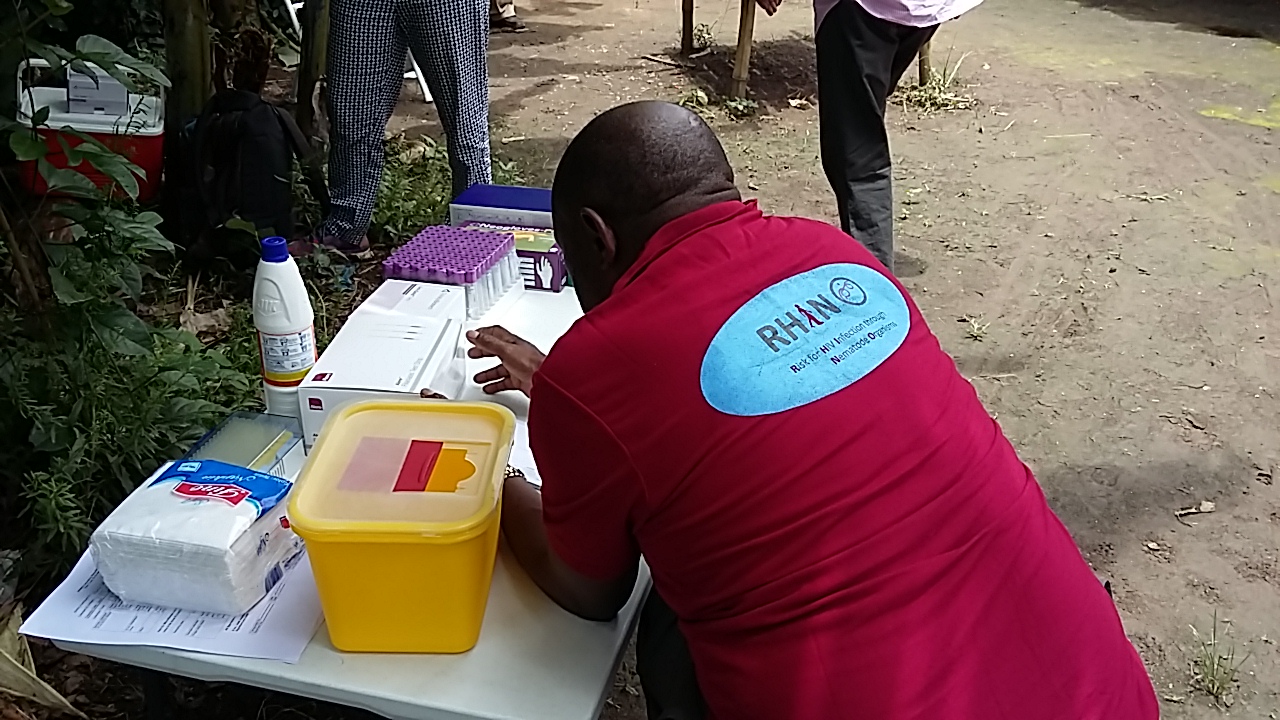
Between 2009 and 2015, villagers in Tanzania were treated annually with antihelminthics as part of a government program to eliminate lymphatic filariasis. Together with researchers from the UKB and the University of Bonn, the Munich and Tanzanian teams took this as an opportunity to conduct a follow-up study (RHINO: Risk of HIV Infections through Nematode Organism) to investigate the impact of the almost complete elimination of W. bancrofti infection on HIV incidence.
In 2019, the research team invited people at one of the EMINI study sites, Kyela, to participate in the RHINO follow-up study. The subjects - a total of 1,139 study participants aged 14 to 65 years - were tested for HIV and W. bancrofti (WB) and divided into three groups accordingly - 1. WB-positive, 2. cured of WB (i.e. WB-positive between 2007 and 2011 and WB-negative in 2019), and 3. WB-negative. In a statistical analysis, the research team then compared the HIV incidence in these three groups in the study periods 2007-2011 and 2011-2019.
The analysis of HIV incidence between 2007 and 2011 showed that WB-infected persons (1.72 cases per 100 person-years/PJ) had more than twice the risk of becoming infected with HIV compared to WB-negative persons (0.69 per 100 PJ). In contrast, the HIV incidence examined in the period 2011-2019 in people who had been cured of WB (0.73 cases per 100 PJ) differed only insignificantly and not statistically significantly from people who had never been infected with WB (0.68 cases per 100 PJ).
In the group of subjects who were cured of W. bancrofti, a comparison of the two study periods showed a reduction in HIV incidence of around 60 percent, which was also statistically significant after adjustment for age and gender (measured odds ratio: 0.41, p=0.012). In the comparison group of people who were not infected with W. bancrofti in either of the two periods, however, there was no change in HIV incidence.
DZIF researcher Prof. Dr. med. Inge Kroidl from the Tropical Institute of the LMU Klinikum concludes: "This confirms the earlier hypothesis that it is indeed the worm W. bancrofti that has an influence on the level of HIV incidence and that combating W. bancrofti can help to reduce the rate of new HIV infections."
"Helminth infections have been shown to increase the risk of HIV infection. We are continuing to investigate which immunological processes could explain this increased susceptibility to HIV transmission by W. bancrofti," says Prof. Michael Hoelscher, MD, Director of the Munich Tropical Institute.
Dr. Mkunde Chachage of NIMR-MMRC emphasizes: "This groundbreaking research demonstrates the importance of engaging communities to identify additional interventions in our regional HIV control strategies and underscores their critical role in shaping effective health initiatives."
Commenting on the findings, Prof. Said Aboud, Director General of NIMR, said: "They demonstrate NIMR's commitment to leading the way in lymphatic filariasis and HIV elimination interventions in Tanzania." He praised the Tanzanian government's long-standing support through the Neglected Tropical Disease Control Program (NTDCP), which has been fighting these diseases for almost 20 years. This has made this research possible, which further advances the fight against HIV.
Co-author of the study Prof. Dr. med. Achim Hörauf, Director of the Institute of Medical Microbiology, Immunology and Parasitology at the University Hospital Bonn, adds: "Our results open up new possibilities for the prevention of HIV in affected regions. The therapy to combat lymphatic filariasis is not yet optimal. We are therefore continuing to research this topic and hope to bring at least some of the new drugs against this infection developed at the DZIF, among others, to approval in the coming years."
Inge Kroidl et al: Impact of quasi-elimination of Wuchereria bancrofti on HIV incidence in southwest Tanzania: a 12-year prospective cohort study. The Lancet HIV 2025, https://doi.org/10.1016/S2352-3018(25)00001-3
Funding and acknowledgements:
The study was funded by the European Union under EuropAid (SANTE/2004/078-545/130; SANTE/2006/129-931, funding the EMINI_Study) and the German Research Foundation (DFG) KR 3615/1-1 and HO 2009/11-1, funding the RHINO study). In addition, IK is funded by the Federal Ministry of Science and Research (BMBF, funding code 01KA2222A). AHoe, CG, MH, BP and IK are funded by the German Center for Infection Research under TTU 03.815 (to AHoe), 03.816 (to BP) and 03.817 (to MH, CG and IK). The funders had no influence on the study design, data collection and analysis, the decision to publish or the preparation of the manuscript. The study team would like to thank the villagers of Kyela region for their interest in the research and their support of the activities over many years.
Unit Head, Research Group Helminth Infections and Co-Infections, Institute of Infectious Diseases and Tropical Medicine, LMU Hospital
Nursing with heart and expertise: Experience the Nursing Careers Day at LMU Hospital on June 27, 2025 - a day full of inspiring insights into the demanding and holistic everyday life of nursing. Meet experts, discover a wide range of career opportunities and receive exciting information on jobs, training and further education. Come along, exchange ideas with colleagues and let yourself be inspired by nursing science in practice - without obligation and without registration.