HOPE Study
Background of the study
Breastfeeding is the best nutrition for babies in the first few months of life. However, there are still many unanswered questions about the composition of breast milk, the factors that influence it and the possible effects on the child. Scientific studies have shown many indications that certain nutrients in breast milk can influence a child's growth, health and development. We would like to take a closer look at the fatty substances in breast milk and their significance for the child's development and find out whether these are influenced by the mother's diet, for example. In addition to diet and lifestyle, we would also like to investigate gestational diabetes and type 1 diabetes mellitus that already existed before pregnancy as possible important influencing factors. Furthermore, we would like to investigate the possible consequences of having had COVID-19 on the metabolism and breast milk composition.
With the newly gained knowledge from this breast milk study, we expect to be able to further improve the recommendations for the nutrition of breastfeeding mothers. An increased intake of individual valuable fats with the milk could, for example, have a positive influence on the health and growth of sick or premature babies.
Who can take part in the study?
For the HOPE study we are looking for
- healthy pregnant women,
- Pregnant women with gestational diabetes,
- Pregnant women with type 1 diabetes mellitus,
who plan to breastfeed their child for at least four months.
Procedure of the study
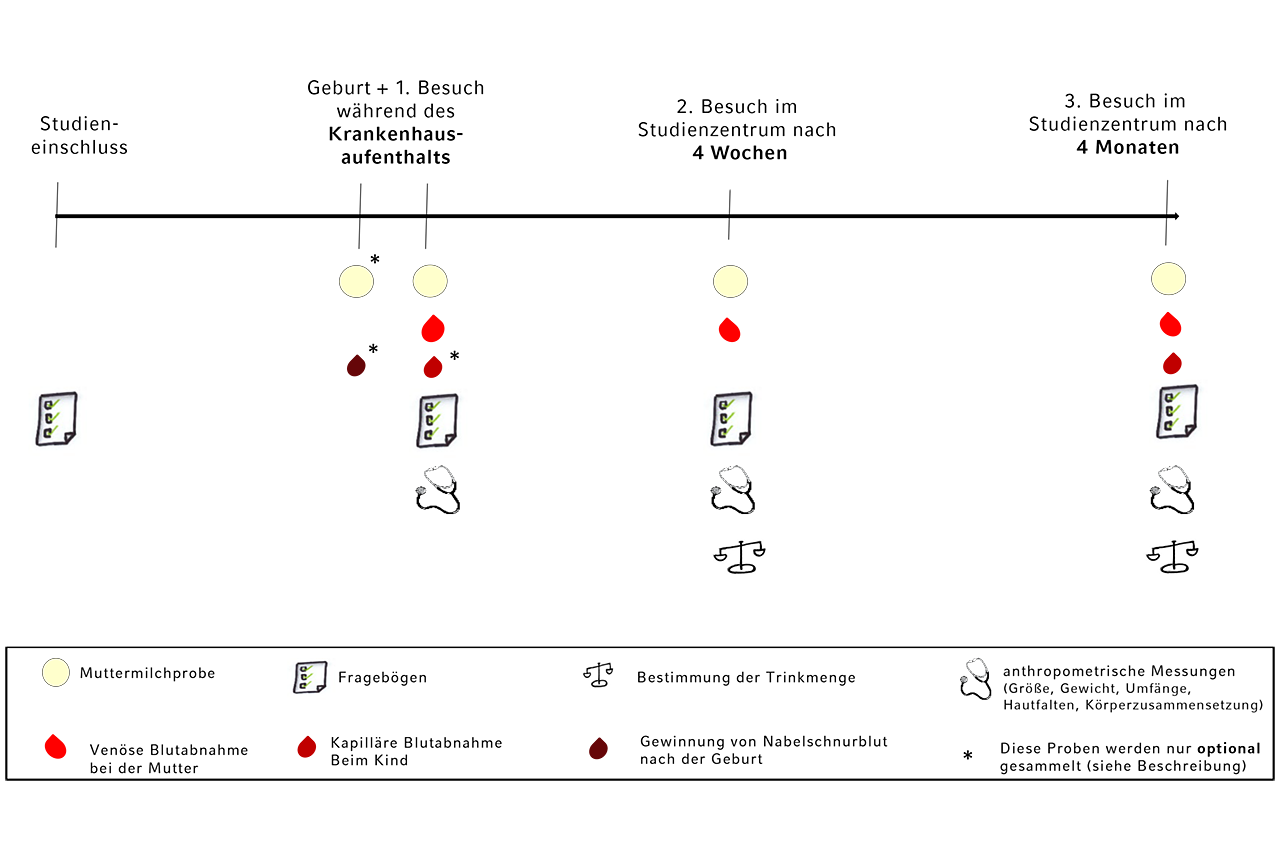
Participants in the HOPE study can expect three appointments: The first appointment takes place within the first three days after birth (usually still in the hospital). A sample of colostrum is collected and approx. 10 mL of blood is taken from the mother. In addition, questionnaires are used to gather information about the birth, the health of mother and child, nutrition and breastfeeding behavior.
In addition, if possible without additional stress for the mother and the child, we will also carry out an examination:
- If the mother collects colostrum before the birth by expressing the breast and brings it to the hospital for the birth, we would be happy to collect a small amount of it.
- If the procedures after the birth allow it, the obstetricians will take approx. 3 ml of blood from the severed umbilical cord. This allows us to gain valuable information about the blood composition of the newborn without having to take blood from the baby itself.
- If blood is taken during routine newborn screening that is no longer required for screening, we would be happy to examine it.
The second study appointment 4 weeks and the third appointment 4 months after birth are almost identical.
The mother comes with her baby to the study center at the Dr. von Hauner Children's Hospital. There, blood is taken from the mother and a breast milk sample is collected. At the third visit, in addition to the mother's venous blood sample, we also need a very small blood sample from the baby in order to be able to examine the connections between the mother's blood, the breast milk and the baby's blood. For this purpose, we use a capillary blood sample taken from the baby's heel.
In addition to the samples collected, the weight, height, various body circumferences and skin fold thicknesses of the mother and child are measured and a body volume measurement is carried out. Information about what exactly the mother ate on the day before the study date is also required in order to be able to investigate the influence of nutrition on the milk composition. For this purpose, the mother is asked to keep a dietary log and complete a dietary questionnaire.
In order to gain a more precise insight into her life situation, we also ask the mother to complete various questionnaires on living conditions, breastfeeding behavior and the health status of mother and child as well as exercise behavior upon inclusion in the study and at the last two study appointments.
In order to determine the exact amount of milk ingredients ingested by the child, we also record the amount of milk consumed. To do this, the mother should weigh her baby at the age of 1 and 4 months for 25 hours before and after each breastfeed and record the measured weights. We provide a special baby scale for this purpose.
Who is conducting the HOPE study?
The Department of Metabolism and Nutritional Medicine at the Dr. von Hauner Children's Hospital (LMU Klinikum) under the direction of Prof. Dr. med. Berthold Koletzko has been studying healthy nutrition in infants and young children for many years. We are investigating how nutrition during pregnancy and early childhood affects children's growth and health in later life.
The detailed analysis of the blood and milk samples collected is carried out in the MS Core Facility of our department using mass spectrometry.
Have we piqued your interest? Would you like to help us better understand breast milk and its protective effect on your infant?
Then we would be delighted to hear from you!
Contact:
Johanna Ruf and Christiane Haesner-Stricker
Children's Clinic at the Dr. von Hauner Children's Hospital, Department of Metabolism and Nutritional Medicine - Principal investigator: Prof. Dr. Dr. Berthold Koletzko